Bopping with Niall JP O'Leary

Niall O'Leary insists on sharing his hare-brained notions and hysterical emotions. Personal obsessions with cinema, literature, food and alcohol feature regularly.

Monday, June 15, 2015

Literary Bleach

Starting to get reading again.  In the last few weeks I have finished a whole murder of horror collections, most of which I had started at some point in the past.
King's 'Nightmares and Dreamscapes' has its fair share of dodgy material, but with so many stories this is to be expected.  It's still entertaining and what I always take from King is his storytelling ability.  The stories are not always the greatest - just look at what too often ends up on the silver screen - but the telling is worth the journey.
Then I finished off Dennis Etchison's 'The Dark Country'.  A totally different kettle of fish.  Aiming more at the high-brow, his stories are resolutely downbeat.  After a point I got a little weary of the whole maliciousness of it all.  I put the book down over midway through some months back.  However, with less left to read I thought I'd try it again.  I am not sure what his problem is with organ transplants, and sometimes the ambiguity of the whole thing irritated me, but in the end he is definitely a voice worth hearing.  Not entirely my cup of tea, but fine in sips.
When I was young, Ray Bradbury, ripe prose and all, was someone I associated with the Twilight Zone style of story and as a result was one of my heroes.  Then I read some of 'Quicker than the Eye' in my later years and started to get a wee bit disillusioned.  Am I just maturing, getting older, or losing my childlike sense of wonder?  Whatever it is I read Bradbury's 'The October Country' a while back to give him another chance.  Not bad.  Some tales are nice and dark (the one about the husband and wife in Mexico, for instance.)  Still though it didn't blow me away and I started on 'The Illustrated Man' more for completeness sake than out of enthusiasm.  After a while I put it down.  Again in the last few days I thought I'd finish it off, and so I did.
I had read some of the stories in this collection before and okay, it is good.  But ultimately there's a superficiality to everything that kind of bores me.  The downbeat bleakness I took from other stories by Bradbury (such as 'The Small Assassin' or 'The Playground') is too tempered by an overdose of sentimentality here.  It's sad stuff, but paper thin too.
I suppose it's the likes of Etchison and particularly the next author I read that has raised my expectations a little.  Robert Aickman's apparently most 'accessible' collection, 'Cold Hand in Mine' is BIZARRE.  He is an excellent writer, but what on earth is he doing?  His description of his own stories as 'strange stories' is the most appropriate description anyone has ever made of their work.  Each one is full of unease, sexual tension and some sort of horror, but rarely is there any closure, and seldom any attempt at explanation.  'The Same Dog' is horrible, but what the hell just happened?!!  'Meeting Mr Millar' is full of the adult character you do not get in Bradbury, but again what is going on?  As to the masterpiece of the collection, 'The Hospice', I really do not know what it was all about, I just know it was nasty.  What was the cat bite about, not that it seemed to be a cat?  Was it a rest home for fans of the Seven Deadly Sins?  What was with the food, the lightbulb, the woman with the perfume, the changing Banner, the EVERYTHING?  Never before have I reached for my phone so many times to look up Aickman to find out what were his views on religion, women, Freud - who the hell was this guy.  He is bizarre, definitely not for everyone, but for those who can take the lack of solid answers, strangely addictive.  It says something that the one story that seems most straight-forward, 'Pages from a Young Girl's Diary', was for me the least interesting.  As a slow, slow reader I was surprised to find I had finished the book in just over two days.  Addictive.
Algernon Blackwood's 'John Silence' stories should be just the thing I like.  Silence is an investigator, or rather specialist, in the supernatural, something along the lines of Hodgson's Carnacki, and acting as a precursor to Kolchak and the X-Files.  However, the stories despite dealing with shape-shifters, mummies, possessions and devils are almost always too genteel to really get the blood racing.  After three or four stories again I had put the book down.  Anyhow there were only three stories left so I picked it up again last night.  'Secret Worship' deals with a coven of Satanists masquerading as monks running a posh, isolated school for toffs (not a million miles from Argento's 'Suspiria', for instance).  You can see immediately how influential it has been as a theme, and Blackwood's John Silence is always at the centre of truly mythic themes.  The story starts well following a former pupil's mysterious compulsion to visit his old school and it builds well too.  You can practically see poor old Christopher Lee, may he rest in peace, as Kalkmann the monk who opens the door and makes the visitor so welcome.  The tension builds.  Even the appearance of the devil is original enough to keep things on a good footing.  However, the entrance of John Silence (previously largely missing from the tale) is something of a damp squib.  He is literally compared to Jesus, and the best sort of English man, while the German monks are equated with evil.  Blackwood slyly amplifies this ludicrous dichotomy with an alignment of merchants and silk-selling with the forces of Goodness.  Capitalism is a very Good thing apparently!  Anyhow I will finish the thing, but Blackwood, for all that he wrote 'The Willows' and 'The Wendigo' is still an awfully silly, not to mention too laid-back, a writer.
Anyhow I am finally starting to clear the reader's block.

Labels: , , , , , ,

Sunday, August 24, 2008

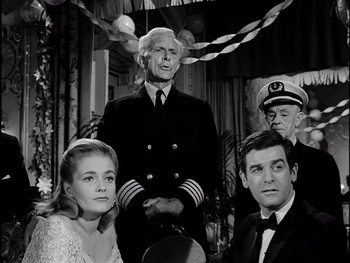
Passage on the Lady Anne

Sailing into the Twilight Zone (Image from http://www.twilightzonemuseum.com/)Sailing into the Twilight Zone
This is not really a 'Twilight Zone' story despite Serling's closing attempt to give it an air of mystery. The Season Four 'Twilight Zone' episode, 'Passage on the Lady Anne' is as close as Charles Beaumont got to writing a standard drama. Goodness knows what he might have been like if they let him loose in the mainstream.
A couple whose marriage is on the rocks take a trip on a rust bucket of a cruise liner in an attempt to save their marriage. Standard fare, you might think, except that they find that they are the only people on board under the age of 75, oldsters who constantly threaten and cajole the couple to get off. This gives the producers the opportunity to trot out some excellent old stars, some regulars of The Twilight Zone series, but given here a chance to show why they got so much work. Wilfrid Hyde-White, Cecil Kellaway, Alan Napier, and good old Gladys Cooper (she who fought Robert Redford's 'Death') form part of a passenger list who have no intention of reaching their destination (whether that be The Twilight Zone or not).
Effectively Beaumont uses a nice interweaved bi-partite structure rather than just subplot/plot; each is as relevant in its own way. On one hand the couple save their marriage (conventionally, but still touchingly), on the other, the ship's crew and passengers plot their own destruction (while deciding the young couple 'need not die'). It's strange how something so sentimental could nevertheless have such an unpleasant theme running through it. Frequently I was reminded of Shirley Jackson and her 'The Summer People' and 'The Lottery'. Afterall this features a mass suicide and bizarre paranoia, and , were Beaumont not writing a 'Twilight Zone' episode, he probably would never have gotten away with it as traditional drama. Instead it can be brushed under the carpet with a few silly words by Serling as epilogue ('they disappeared into the Twilight Zone').
Needless to say the cast are excellent - Wilfred Hyde-White, Kellaway and Cooper standouts - with only Lee Phillips, as the young husband, letting the side down a little. It should also be said that director, Lamont Johnson, pulls off a few uncharacteristically distinctive shots (a close two shot by the rail, a shot through stairs), and the overall atmosphere is claustrophobic and decaying. A lot of this is achieved through the masterful stroke of using the ship's engines as a constant heartbeat to the story. Yes, indeed, there is a lot more going on here than meets the eye.
It's so easy to dismiss this episode as sentimental tosh, but think of what's actually going on (and how easy the oldsters were prepared to let the youngsters die), and you have to look again. It may be rose coloured light, but it's against a very dark backdrop. Pervading all Beaumont's episodes is a melancholy, a nostalgic yearning for a past world he could not have known (remember "Long Live Walter Jameson"). According to some sources this is his last authentic episode (later ones being ghost-written by Jery Sohl). It seems appropriate. So sad he died so young (38).

Labels: ,

Wednesday, June 25, 2008

The Mist

The Mist
The Mist

After 'The Shawshank Redemption' and 'The Green Mile', writer/director Frank Darabont returns to Stephen King territory with 'The Mist'. After a mysterious mist descends on small town, Castle Rock, bringing with it a multitude of strange man-eating creatures, shoppers find themselves trapped in the local foodstore. Soon, as in the Twilight Zone episode 'The Monsters Are Due on Maple Street', they find that they have as much to fear from the monsters lurking inside than the CGI ones stalking the car park.
I won't begin to spotcheck the variety of sources this movie, or rather the novella it is based on, references; it doesn't really matter. King's strength has never been his originality, but how he uses common genre tropes to achieve contemporary, socially relevant ends. (I will note, however, that there is an interesting contrast between this film and Romero's 'Dawn of the Dead'; one has a small number of people in a huge mall, while the other, representing small town America and all its prejudices, sees a large group of people trapped in a relatively small store.)Despite a little too much talk, this is a fascinating, and brave, horror. Indeed given that the norm in contemporary horror is to sacrifice character in the service of plot, it is refreshing to have something to think about while you squirm, and the characters - stereotypes one and all though they might be - are deliberately used to give us a microcosm of America. (It's also good to have a kid behave like a kid, even if that means being annoying; better that than the precocious beasts we more often have to suffer.)
Trapped in the store, prejudices (often centering on those who are not 'local') soon bubble over and create sides when everyone should be uniting. Fear, as the characters themselves point out, on the one hand puts us in the hands of monsters, and on the other, and indeed as a result, makes monsters of us all. Marcia Gay Harden's Christian fundamentalist is the primary source of the polarisation. Beginning as a figure of fun, she rapidly becomes a mini-Hitler. She is just the most visible human monster though; no one really survives the onslaught.
On the outside an impressive, but often very familiar, array of beasties keep the pressure on the survivors. I am not one for CGI appreciation, but though the pixels do sometimes show, the inter-dimensional monsters do their job, instilling terror in shoppers and audience alike. We are never in any doubt that what lies in the mist is best left there. Again though, they are something of a McGuffin, or rather a mechanism, to set the real monsters loose.
The movie had a lukewarm reception in America and probably won't break box office records here either. It's far from perfect. Certainly the damning portrait of the silent majority could not have helped in the US. The real reason audiences might baulk though is undoubtedly the ending. If what has gone before was Lovecraft, what finishes proceedings is pure Ambrose Bierce ('THE COUP DE GRÂCE' anyone?), and if the movie were tighter, this would be one of the best contes cruels of recent times. But contes cruels are an acquired taste and that ending probably won't help here either. Neither will the frequent longuers. However, for the cynical among us (and there's still a couple of us), the film's negative view of humanity, and indeed Fate, cannot but appeal. Yea, as Hobbes put it, 'Life is nasty, brutish and short'; and then there's those damn tentacled, inter-dimensional thingies. We just can't win!

Labels: , , , , , ,

Sunday, May 25, 2008

Hellfire and Violinists

Speaking of things demoniacal, I read a short story, 'The Bishop of Hell', by Majorie Bowen. Poor stuff, no doubt inspired by Byron, though the last image of the eponymous bishop anticipates the Ghost Rider iconography.

(Just did a little search: how could a writer so dull come up with a novel called 'Black Magic: A Tale of the Rise and Fall of the Antichrist'?)

Speaking of anticipation, one episode of the the fourth season of 'The Twilight Zone' (1963) (when the format went hour long), a story by Charles Beaumont called 'Valley of the Shadow', anticipates both the replicator and the transporter from Star Trek. A reporter gets lost and ends up in Peaceful Valley, a town with a secret so big they don't want him to leave. It also reuses his earlier 'The Howling Man' theme, wrapping it in pseudo-scientific garb and changing the ending for a less apocalyptic denouement.

Only getting around to the fourth series now, I also watched 'He's Alive' and was startled to see a young Dennis Hopper take centre stage playing Hitler's American protegée. Given the episode's preoccupation with the evils of the Nazis, it had to be a Rod Serling story. Not the greatest story, but Hopper is pretty electric.

And that reminded me of a film that featured a rivetting performance by William Shatner (honest!) in a similar role. Roger Corman's 'The Intruder' is well worth a look.

Watching 'Poltergeist 2' for the first time yesterday (it was on at teatime on MGM, so why not?), I realised why I have avoided it for so long. It's no good and does a great disservice to the great original (that's why not). Do you really need to explain the previous events with an evil cult?

Di Caprio's environmentally friendly 'The 11th Hour' was on tonight; now that's a documentary that might have benefitted from a little intervention from the Bishop of Hell. Catching the last twenty minutes, it nearly sent me out to the nearest MacDonald's (leaving the lights and tv on while I went) to buy a Big Mac with which to litter the street (wrapper and burger would I discard, for even an evil me couldn't eat one of those things). When you hear crap like 'Love is what makes us human', you almost want the Bush's of this world to destroy us all. No, love is not what makes us human and it ain't going to save the environment either. Recognition that we're all going to die if we don't do something about it might. Hell, just go to Peaceful Valley and ask why we can't have the replicator!

Maybe the rest of it was better. I suppose when it comes to the environment, even 'bad' publicity is good publicity.

Luckily evil me did not make an appearance at the retirement party last Friday. I was reasonably well-behaved. I tried to chat up the female entertainment, a fetching Dundalk violinist, by discussing Prokofiev's First Violin Concerto, but she preferred U2 'any day'. That didn't shake me though, nor did the wine, Guinness, sambuccas or lager. Forgive me Bishop, for I didn't sin.

Labels: , , ,

Monday, April 07, 2008

The Orphanage

The Orphanage - From wikipedia.orgThe Orphanage - From wikipedia.org
The mother battling against the supernatural for her child has become something of a staple in modern horror cinema. 'Dark Water', 'Silent Hill', 'The Dark', 'The Others' and 'Ring' are all recent examples. 'The Orphanage', directed by J.A. Bayona, though 'presented' (produced) by Guillermo Del Toro (of 'Pan's Labyrinth' fame), is yet another entry in this mini-genre. In its tale of a woman who apparently loses her son to the ghostly children of an old orphanage and must endure the worst in an attempt to rescue him, its story might seem to be a little tired. But is it?

Besides the aforementioned, the list of movie references here goes on and on. There's 'The Innocents' (adapted from Henry James' 'The Turn of the Screw') and Del Toro's own 'The Devil's Backbone' and 'Pan's Labyrinth'. Of recent films, it most closely resembles 'The Dark' with its seaside location and a lead who even resembles that earlier film's heroine, Maria Bello. There too a child was lost (perhaps drowned), but the mother sensed her continued presence in the old house in which they dwelt and fought against supernatural forces to rescue her. That movie introduced the theme of the Changeling and it is probably in that sinister fairytale of child abduction that all these movies probably have their great-great-grandmother.

A director in whose movies this theme has popped up more than once is Steven Spielberg. This theme surfaced in Spielberg's 'Close Encounters of the Third Kind', 'Indiana Jones and the Temple of Doom' and obviously in 'Hook' (dealing with a grown-up Peter Pan). From a horror perspective though, the Spielberg-produced (and penned) 'Poltergeist' could be the key to the recent spate of children in peril movies. As I mentioned before, that movie owes more than a little to Richard Matheson's Twilight Zone story, 'Little Girl Lost'. Matheson gave his tale a science fiction twist, but it doesn't take much to relate it to the original fairytale, with the Fourth Dimension standing in for Faerie (and Neverland). Certainly 'Poltergeist' has a narrative trajectory that closely follows both 'The Orphanage' and 'The Dark', though what had been a team effort by both parents has become (in this less nuclear age) almost a one-woman show ('Dark Water' makes its mother a single mum). Spielberg is too sentimental to allow things get too dark, however, and most of his abduction tales draw upon that more optimistic incarnation of the myth, Peter Pan. The notion of a roguish outsider seducing children away to Neverland is as close to the more malevolent notion of the abduction of infants by fairies as you can get without scaring your audience (though the Dark Side is always there; remember how Pan's Indian tribe, the Lost Boys, became the inspiration for a vampire flick of that name).

Bayona shares Spielberg's preoccupation with this Pan (rather than the Pan of his mentor, Del Toro), and the child who refused to grow up hovers over every frame of this movie. (Indeed, in a recent interview Del Toro gushed how Bayona was a new Spielberg.) Spielberg's grand theme of the loss of childhood and the wish for a return to its innocence, shines through in Laura's obsessive search for Simon, while a Peter figure, the child, Tomas, seems to mastermind the taking of the child to a dark Neverland. Here too, the materialism of an 'adult' world is contrasted with the spiritualism of the child and the realm this film's children inhabit. And, as in 'Poltergeist', a wise medium (an on-key Geraldine Chaplain) is brought in to identify the problem, dispense wisdom and bridge the two worlds. So far so Spielbergian. What is special here is that Bayona for all that he manifests a keen awareness of how to push the audience's emotional buttons, resists sinking into the sentimentality that mars Spielberg's work. In every respect, from the film's narrative dualism (materialistic/spiritualistic explanations are offered, though only one really works), from its combination of subtle scares and gruesome horror, and supremely in its heartwrenching mix of extreme pain and joy, he has his cake and eats it. Indeed he delivers the cake American Cinema loves to churn out, but he knows how to temper it to the more ascerbic tastes of Europe.

Having said all that, though his themes mirror Spielberg, and excellent director though Bayona proves himself to be, his style is not that of Spielberg. It is a lot less showy and not above the occasional shock tactic. And he's none the worst for that. Indeed, he is, in my view, all the better.

'The Orphanage' has no new story to tell. It is an old tale, already told many times in recent memory, and with many of the distinguishing marks of those films. It is then wonderful to relate that it ranks with the very best of those films and is well worth the retelling. Humane, painful and very scary, it marks another welcome addition to another growing sub-genre, the Spanish-language Ghost Child Film. Well might Del Toro present it.

Labels: , , , , ,

Tuesday, April 01, 2008

Score!

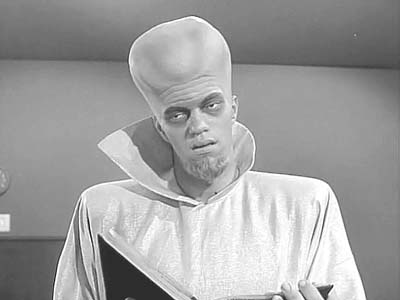
To Serve man - From www.scifi-universe.comFrom www.scifi-universe.com
I have to say it again, a great score by a great composer can raise a film to a whole new level. Just watched yet another Twilight Zone episode, "Nightmare as a Child" (there's 156 or so of them, so I still have a lot to get through). Right from the opening you notice the music, very reminiscent of Ennio Morricone's works. Just like Morricone (remember 'Once Upon a Time in the West' or 'Once Upon a Time in America'), it used a childhood style and theme to put the past into the present, very much in keeping with the story. And who was it? Jerry Goldsmith, of course! Though he wrote only a handful of scores for the series, you notice every one. Excellent!
A day or two back too, I watched 'Little Girl Lost'. You know it's a classic when 'The Simpsons' use it as the basis for an episode (like 'The Shelter' or 'To Serve Man'), and 'Little Girl Lost' serves as the basis for Homer's experience in the Third Dimension. It's also written by Richard Matheson, which helps, although the father's immediate response when his daughter disappears is to 'call a physicist'. Hmmmmm! Perhaps not the most realistic of responses, Richard. Traditionally the third season of The Twilight Zone opens with a 'Produced by' credit, 'Written by', and 'Directed by'. In this episode though and very unusually, the main credit after Producer is 'Music by'. Rightfully so too, for the score is by none other than Bernard Herrmann, frequent collaborator with Hitchcock, composer of the theme and a lot of music for the first season, and one of the all time greats. The score itself is very like earlier scores by Herrmann, it must be said, but it lends a gravitas to the episode that raises it far above the ordinary. Another point: quite apart from The Simpsons, this particular episode obviously inspired 'Poltergeist', right down to the little girl. Excellent!!!!!
And while I'm at it, 'To Serve Man', based on a story by Damon Knight, again a story I read as a child (and loved), I watched the other night too. I must have seen it before, but the punchline is such a good one that it deserves repeated viewing. Richard Kiel as a nine foot tall alien with a huge forehead is also worth the watch. Excellent!!!!!!!!!!!!!!
(There's a bit of trivia relating to 'Naked Gun 2 1/2: The Smell of Fear' mentioned on the wikiepedia entry for 'To Serve Man'. If you know the punchline, it's a good one. If you don't, read the story!!!!!!!! And someone's put the episode on Google! I want to scream out the punchline!!!!!!!!)

Labels: , , , , , , , , ,

Wednesday, March 26, 2008

What Do You Do When the Monks Want to Eat You?

Still Valley - From wikipedia.orgFrom wikipedia.org
I've started to dread the credit "Written by Rod Serling" when watching The Twilight Zone. Don't get me wrong, I've sang his praises in the past and still do; he was a superb craftsman. Too often though he was just too damn matter of fact. Also he sometimes allows his prose to run away with him (a little like Ray Bradbury). Then there are those similar themes surfacing again and again (the little man with a chance of redemption, the Nazi getting his come-uppance, the nostalgic yearning for the past). I watched his later series, 'Night Gallery' recently (and more on that later), but even there the episode that got Emmy-nominated, Serling's "They're Tearing Down Tim Riley's Bar" is a very close reworking of Serling's earlier Twilight Zone episode, 'The Trouble with Templeton'. It's also conspicuously out of kilter with the refreshing darkness of the rest of the series, being hopelessly maudlin (as usual, I'm probably in the minority on this one). Serling at his worst has his characters declaim 'seriously' in sentimental yarns lacking bite. This is the Twilight Zone, Rod, take some drugs, get drunk, have an orgasm, but get out of your dogmatic mind, for goodness sake!
Anyhow! Series Three seems to be a monumental slog by him, every episode signed 'Written by Rod Serling' (it is a prodigious feat of creativity, it must be admitted), but thankfully tonight there was one "Based on a story by Manly Wade Wellman: 'Still Valley'. Not by any stretch a masterpiece, but I recognised it as a story I'd read years ago. Set in the American Civil War, it was about a sorcerer in a Southern States town threatening to overthrow the Union army through witchcraft. The story was better than Serling's adaptation, but it still boosted me no end to see it onscreen. There's a lot in the back catalogues, folks.
Yes, the back catalogue. Once upon a time I wrote a tv series using such tales. Naturally it was never produced, but it did get me noticed by an American couple who ran a small production company. I was 'Shakespeare', they 'loved me', 'Come in and see us!' I did. They didn't want to produce my series. Instead they wanted me to write their script based on a treatment they supplied. It was wonderfully tacky stuff about blind Templar monks coming back from the dead, though there was little to the treatment and what there was was probably ripped off from Amando de Ossorio's BLIND DEAD series of zombie movies about the same subject. Nevertheless I agreed to tackle it.
Asking about a fee though changed the atmosphere. Warmth turned to chill. Between bouts of writing I consulted friends, checked with the Writer's Museum, Filmbase, etc., and the advice was the same; do nothing for nothing! Even if it's a small nominal sum, any payment would show their commitment to me. Otherwise they could have several writers working on the same thing and in the end they could choose whatever version they liked with no monetary loss. I had to have it out with them, and have it out with them I did. I was accused of not trusting them. Well, maybe, but they held all the cards and I was an out-of-work wannabe scriptwriter. I asked for a very small figure, maybe one hundred euros. After all I had done a lot of work at that point (little did they know I actually had a first draft written). No! I was a viper! I shamed them! Down the stairs! I was evicted from the office and that, my friends, was the end of that.
A shame though. I liked that script, if I do say so myself (nice scene in a library; sex scene with a seal), but as they owned the treatment, I don't own the rights. A salutary lesson in scriptwriting taught and learnt in a classroom we fondly call The Twilight Zone.

Labels: , , , , ,

Sunday, February 17, 2008

Off Warbling Somewhere in Frenchy Speak

Image from www.wikipedia.orgImage from www.wikipedia.org
I really have to give up those 4 a.m. drunken bursts of written diarrhoea. In the end a good night was had by all, including, I am sure, the Cavan masseuse.
You know there cannot be a shirt in my wardrobe that hasn't been besmirched by my love of olive oil. And as for that old chestnut about a hot iron and some brown paper, that's all it is, an old chestnut, and tree seeds have no place in modern laundry practice. I should know; I worked in a professional laundry for three years (well, summers). Blithely I emptied out the sacks of urine-soaked pyjamas and operating room balls of fat on to the conveyor belt. I had sacks of blood drip by my feet from the overhead rails. They even found an amputated hand where I worked (a week before I started). Yes, an industrial laundry that tackled hospital and hotel garments and linen. Anyhow I still never learnt how to iron a shirt.
Believe it or not, short though it is, I only got round to finishing 'Three Men in a Boat' the other day. Very lightweight - never likely to provoke more than a smile - it just couldn't generate enough enthusiasm in this reader to keep me reading for any length of time, though it would never alienate me enough to make me throw it away. Still, although the jokes don't quite do it in this day and age, it is something of a masterclass in how to write comedically over an extended piece of work. Hypocrisy and misdirection are used well, if too repeatedly, and the whole comes across as less of a novel and more a transcribed comedy routine from some observational nineteenth century stand-up.
Series Two of 'The Twilight Zone' isn't up to the standard of its predecessor. Four lemmons in a row today, all of them from Mr Serling. He seems to have let his sentimentality and didacticism run roughshod over his sense of story. It's a relief to get Matheson's 'The Invaders', a somewhat famous episode about an old woman in a farmhouse attacked by the diminutive occupants of a flying saucer. What's really worthy of note in the second series is the development of Jerry Goldsmith as a composer. His music makes itself felt everytime it's used (you know when it's a Goldsmith episode). 'The Invaders' episode, in particular, has a score that looks forward to his classic film music for 'Alien' and 'The Omen', despite the fact that the episode was broadcast in 1961. Fantastic!

Labels: , ,

Sunday, February 10, 2008

From the Outskirts

From www.wikipedia.orgFrom www.wikipedia.org
Why do so many of 'The Twilight Zone' episodes happen on the outskirts of the Twilight Zone (I'm just going by Mr Serling's introductions). What the hell would it be like in the centre?

I watched an episode earlier entitled 'The Lateness of the Hour'. In terms of direction, dialogue and even acting, this was one of the worst of both seasons. It says a lot for the series then that it prefigures much of the Rachael subplot in 'Bladerunner'. Of course, Dick, the author of the original novel (written in 1966), dealt with the whole question of what it means to be human throughout his entire career (which started in the early 50s). The use of robots to highlight this question features in literature a lot earlier too; consider Hoffmann (and in particular, his 'The Sandman') or even, one could argue, 'Pinocchio' (think of Spielberg and Aldiss' take on the story in 'A.I.'). Still the Twilight Zone episode explicitly deals with a robot, with false memories of childhood, believing itself to be human, but coming to the realisation that it is not.

On a side note, it's funny how the use of an abrasive bit of music to drive home the punchline can put a particular interpretation on the ending.

As another aside, the young star of this episode, Inger Stevens, led a particularly tragic life. She had a nasty habit of having affairs with her costars, the last one with Burt Reynolds. Never happy though, she committed suicide at the age of 35. It then emerged that she had been married to African American actor, Ike Jones, for ten years, but this had been covered up for the sake of her career. The 60s really were a different time.

Labels: ,

Saturday, February 09, 2008

Zoned Out

Image from www.scifi.comImage from www.scifi.com
I should mention that a week or so ago I finished watching Season One of the original Twilight Zone series. All my life my preference has been for the Richard Matheson ('The Last Flight', 'Third from the Sun') and Charles Beaumont ('Perchance to Dream', 'Long Live Walter Jameson') tales. My esimation of Rod Serling, who wrote the bulk of Season One (and of the other four seasons too; apparently over 120 25 minute episodes) has just grown and grown. Despite a moralistic tone, some occasionally clunky dialogue and a definite streak of sentimentality, his tales are showcases of good storytelling. Perfectly formed, they tend to center on an urban nobody, a thirty-something loser, given a chance at redemption, he something takes, but as often rejects ('The Big Tall Wish'). 'The Twilight Zone' features so heavily in my psyche, having made such a big impact from my childhood television viewing, that I could write on and on about its strengths and weaknesses. I won't. I'll just say there are some masterpieces: Burgess Meredith in 'Time Enough at Last' (though a little too schematic this viewing around), 'The After Hours', 'And When the Sky Was Opened', and 'The Monsters Are Due on Maple Street'. That last one is particularly famous, but I could not remember having seen it before. Despite two aliens with antennae (who nevertheless must form the basis for the alien duo from 'The Simpsons'), this is a powerful tale of human weakness which starts humbly and builds inexorably to the final frightening frenzy. Masterly.
I'm on to Season Two now and delighted in Beaumont's classic 'The Howling Man' last night. Then there was William Shatner in 'Nick o' Time', with the bobbing devil-headed, napkin-dispensing fortune teller (Matheson has Shatner's character's psychology just right). They really don't make them like that any more, and more's the pity.

Labels: , ,