Bopping with Niall JP O'Leary

Niall O'Leary insists on sharing his hare-brained notions and hysterical emotions. Personal obsessions with cinema, literature, food and alcohol feature regularly.

Monday, April 07, 2008

The Orphanage

The Orphanage - From wikipedia.orgThe Orphanage - From wikipedia.org
The mother battling against the supernatural for her child has become something of a staple in modern horror cinema. 'Dark Water', 'Silent Hill', 'The Dark', 'The Others' and 'Ring' are all recent examples. 'The Orphanage', directed by J.A. Bayona, though 'presented' (produced) by Guillermo Del Toro (of 'Pan's Labyrinth' fame), is yet another entry in this mini-genre. In its tale of a woman who apparently loses her son to the ghostly children of an old orphanage and must endure the worst in an attempt to rescue him, its story might seem to be a little tired. But is it?

Besides the aforementioned, the list of movie references here goes on and on. There's 'The Innocents' (adapted from Henry James' 'The Turn of the Screw') and Del Toro's own 'The Devil's Backbone' and 'Pan's Labyrinth'. Of recent films, it most closely resembles 'The Dark' with its seaside location and a lead who even resembles that earlier film's heroine, Maria Bello. There too a child was lost (perhaps drowned), but the mother sensed her continued presence in the old house in which they dwelt and fought against supernatural forces to rescue her. That movie introduced the theme of the Changeling and it is probably in that sinister fairytale of child abduction that all these movies probably have their great-great-grandmother.

A director in whose movies this theme has popped up more than once is Steven Spielberg. This theme surfaced in Spielberg's 'Close Encounters of the Third Kind', 'Indiana Jones and the Temple of Doom' and obviously in 'Hook' (dealing with a grown-up Peter Pan). From a horror perspective though, the Spielberg-produced (and penned) 'Poltergeist' could be the key to the recent spate of children in peril movies. As I mentioned before, that movie owes more than a little to Richard Matheson's Twilight Zone story, 'Little Girl Lost'. Matheson gave his tale a science fiction twist, but it doesn't take much to relate it to the original fairytale, with the Fourth Dimension standing in for Faerie (and Neverland). Certainly 'Poltergeist' has a narrative trajectory that closely follows both 'The Orphanage' and 'The Dark', though what had been a team effort by both parents has become (in this less nuclear age) almost a one-woman show ('Dark Water' makes its mother a single mum). Spielberg is too sentimental to allow things get too dark, however, and most of his abduction tales draw upon that more optimistic incarnation of the myth, Peter Pan. The notion of a roguish outsider seducing children away to Neverland is as close to the more malevolent notion of the abduction of infants by fairies as you can get without scaring your audience (though the Dark Side is always there; remember how Pan's Indian tribe, the Lost Boys, became the inspiration for a vampire flick of that name).

Bayona shares Spielberg's preoccupation with this Pan (rather than the Pan of his mentor, Del Toro), and the child who refused to grow up hovers over every frame of this movie. (Indeed, in a recent interview Del Toro gushed how Bayona was a new Spielberg.) Spielberg's grand theme of the loss of childhood and the wish for a return to its innocence, shines through in Laura's obsessive search for Simon, while a Peter figure, the child, Tomas, seems to mastermind the taking of the child to a dark Neverland. Here too, the materialism of an 'adult' world is contrasted with the spiritualism of the child and the realm this film's children inhabit. And, as in 'Poltergeist', a wise medium (an on-key Geraldine Chaplain) is brought in to identify the problem, dispense wisdom and bridge the two worlds. So far so Spielbergian. What is special here is that Bayona for all that he manifests a keen awareness of how to push the audience's emotional buttons, resists sinking into the sentimentality that mars Spielberg's work. In every respect, from the film's narrative dualism (materialistic/spiritualistic explanations are offered, though only one really works), from its combination of subtle scares and gruesome horror, and supremely in its heartwrenching mix of extreme pain and joy, he has his cake and eats it. Indeed he delivers the cake American Cinema loves to churn out, but he knows how to temper it to the more ascerbic tastes of Europe.

Having said all that, though his themes mirror Spielberg, and excellent director though Bayona proves himself to be, his style is not that of Spielberg. It is a lot less showy and not above the occasional shock tactic. And he's none the worst for that. Indeed, he is, in my view, all the better.

'The Orphanage' has no new story to tell. It is an old tale, already told many times in recent memory, and with many of the distinguishing marks of those films. It is then wonderful to relate that it ranks with the very best of those films and is well worth the retelling. Humane, painful and very scary, it marks another welcome addition to another growing sub-genre, the Spanish-language Ghost Child Film. Well might Del Toro present it.

Labels: , , , , ,

Tuesday, April 01, 2008

Score!

To Serve man - From www.scifi-universe.comFrom www.scifi-universe.com
I have to say it again, a great score by a great composer can raise a film to a whole new level. Just watched yet another Twilight Zone episode, "Nightmare as a Child" (there's 156 or so of them, so I still have a lot to get through). Right from the opening you notice the music, very reminiscent of Ennio Morricone's works. Just like Morricone (remember 'Once Upon a Time in the West' or 'Once Upon a Time in America'), it used a childhood style and theme to put the past into the present, very much in keeping with the story. And who was it? Jerry Goldsmith, of course! Though he wrote only a handful of scores for the series, you notice every one. Excellent!
A day or two back too, I watched 'Little Girl Lost'. You know it's a classic when 'The Simpsons' use it as the basis for an episode (like 'The Shelter' or 'To Serve Man'), and 'Little Girl Lost' serves as the basis for Homer's experience in the Third Dimension. It's also written by Richard Matheson, which helps, although the father's immediate response when his daughter disappears is to 'call a physicist'. Hmmmmm! Perhaps not the most realistic of responses, Richard. Traditionally the third season of The Twilight Zone opens with a 'Produced by' credit, 'Written by', and 'Directed by'. In this episode though and very unusually, the main credit after Producer is 'Music by'. Rightfully so too, for the score is by none other than Bernard Herrmann, frequent collaborator with Hitchcock, composer of the theme and a lot of music for the first season, and one of the all time greats. The score itself is very like earlier scores by Herrmann, it must be said, but it lends a gravitas to the episode that raises it far above the ordinary. Another point: quite apart from The Simpsons, this particular episode obviously inspired 'Poltergeist', right down to the little girl. Excellent!!!!!
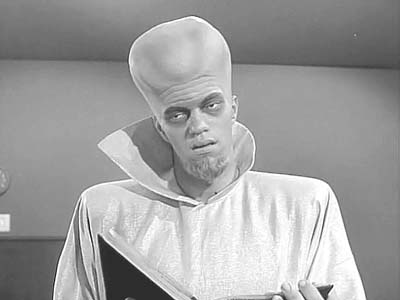
And while I'm at it, 'To Serve Man', based on a story by Damon Knight, again a story I read as a child (and loved), I watched the other night too. I must have seen it before, but the punchline is such a good one that it deserves repeated viewing. Richard Kiel as a nine foot tall alien with a huge forehead is also worth the watch. Excellent!!!!!!!!!!!!!!
(There's a bit of trivia relating to 'Naked Gun 2 1/2: The Smell of Fear' mentioned on the wikiepedia entry for 'To Serve Man'. If you know the punchline, it's a good one. If you don't, read the story!!!!!!!! And someone's put the episode on Google! I want to scream out the punchline!!!!!!!!)

Labels: , , , , , , , , ,

Saturday, February 09, 2008

Zoned Out

Image from www.scifi.comImage from www.scifi.com
I should mention that a week or so ago I finished watching Season One of the original Twilight Zone series. All my life my preference has been for the Richard Matheson ('The Last Flight', 'Third from the Sun') and Charles Beaumont ('Perchance to Dream', 'Long Live Walter Jameson') tales. My esimation of Rod Serling, who wrote the bulk of Season One (and of the other four seasons too; apparently over 120 25 minute episodes) has just grown and grown. Despite a moralistic tone, some occasionally clunky dialogue and a definite streak of sentimentality, his tales are showcases of good storytelling. Perfectly formed, they tend to center on an urban nobody, a thirty-something loser, given a chance at redemption, he something takes, but as often rejects ('The Big Tall Wish'). 'The Twilight Zone' features so heavily in my psyche, having made such a big impact from my childhood television viewing, that I could write on and on about its strengths and weaknesses. I won't. I'll just say there are some masterpieces: Burgess Meredith in 'Time Enough at Last' (though a little too schematic this viewing around), 'The After Hours', 'And When the Sky Was Opened', and 'The Monsters Are Due on Maple Street'. That last one is particularly famous, but I could not remember having seen it before. Despite two aliens with antennae (who nevertheless must form the basis for the alien duo from 'The Simpsons'), this is a powerful tale of human weakness which starts humbly and builds inexorably to the final frightening frenzy. Masterly.
I'm on to Season Two now and delighted in Beaumont's classic 'The Howling Man' last night. Then there was William Shatner in 'Nick o' Time', with the bobbing devil-headed, napkin-dispensing fortune teller (Matheson has Shatner's character's psychology just right). They really don't make them like that any more, and more's the pity.

Labels: , ,

Wednesday, January 24, 2007

Snotty nosed and sniffling

Just a little more on last night's strange meeting. I was typing away in the Internet cafe beside the backpackers, writing to a few friends from my old workplace, DCU. When I left on my careerbreak last July, I was leaving a week after another employee in the HR department, Martin. I would know Martin well enough having worked on his department's website. Anyhow he was also doing some travelling. How that travelling got him to the very same Internet cafe as me, in Dunedin of all places, at the very same time, I will never know, but he walked in just as I was finishing the DCU emails. It turns out he has practically been making the same trip in New Zealand as me on almost the same days (some will see that as explanation enough). Anyhow we went for a pint or two and swapped notes. He heads on to Australia and then Japan next. I think back to meeting Micheal from DCU in the airport when I left, and then Hanlie, my South African friend, in Paris and I wonder. The phrase, 'small world', doesn't cover it.

Last night I read a copy of Empire lying around in the lounge. Some worrying film news. They have finally gotten around to making the long planned adaptation of Richard Matheson's classic sci-fi/horror, 'I am Legend'. Once upon a time they were casting Arnold Schwarzenegger, but now they have settled on Will Smith. Not sure I like the sound of this. What I read about the Arnie version deviated quite a lot from the book and I have no reason to think they've reverted to the original source for this. I still think the much maligned version with Vincent Price, 'The Last Man on Earth', gets an unfairly bad rap. It's as close to the novel as you can get (Matheson wrote the original screenplay, though he disowned it later). Worried.

Suffering now with a cold that has blossomed. Dunedin weather is too much like home to be funny. I will say though that I got a very good feeling about this city when we arrived. It's very European, or rather of the British Isles, and the buildings actually have a look of history about them.

Labels:

Saturday, October 28, 2006

Horror Sequels: Revenge of the Toenail!

Thursday I shaved away my beard intending to be photographed as I intended to travel. Passport photos were required for a Chinese visa I need, but in the end the Chinese Embassy was closed for visas Thursday afternoon and all day Friday, so I'll have to go out on Tuesday. The day wasn't wasted though; I bought my plane tickets and met up with Barry B. for lunch. Thanks again Barry.

On Friday I continued my lunch dates. In contrast to what was to follow, I had a very pleasant Italian lunch with Ali (stunning as ever). Pasta, wine and good company are perfect for a Friday lunchtime. The afternoon, perhaps something I might normally fill with films, was a relaxing lounge around town. There have been no interesting film releases for weeks, however, all was not entirely dead cinematically as I had another venue for getting my fix; the Dublin Horror Movie festival, the Horrorthon.

Intrigued by the prospect of seeing new work by John Carpenter and Tobe Hooper, last night I went along to a screening of three episodes of the "Masters of Horror" series. This series, only aired in the States, takes well-known directors of the genre (eg. Coscarelli, Argento, Stuart Gordon), gives them 2 million and 10 days and asks them to come up with an hour long tv episode. John Landis completed the trio with a piece called "Deer Woman", but I was less interested in that. Landis is rightly lauded for "An American Werewolf in London", but outside of "Innocent Blood" hasn't done much else of genre interest. No, Carpenter and Hooper, despite the disappointment of recent years, are always auteurs to watch. Predictably though it was Landis's piece, laced with humour, which proved to be the best of the three even with (or probably because of) a totally implausible monster called, you guessed it, a deerwoman. Anyhow below are some reviews I put into the IMDB. There may be, as they say, spoilers.

[WARNING! The next paragraph includes toenail scenes of a graphic nature that some readers may find offensive.]

All was well when I got home, but at 1.30 in the morning my big toe began to throb. By 2.00 it was agony. Out with tweezers and scissors, I tried to tackle what was yet another ingrown toenail, or rather the recurrence of my first one. What was happening to me? What was wrong with my toes? I took away some nail, but could get nowhere and ended up getting very little sleep. Emergency! I looked up Golden Pages and got a chiropodist in Lucan who could see me at 12 today. I won't dwell any more on this. Suffice to say he had to anaesthetise the toe (more needles!). It was major. He extracted a HUGE piece of hidden nail, nail I never even suspected and nail that I carried around with me in a little wad of tissue for the rest of the day. He suspects I suffered a foot injury some months back that has caused the problems I've had. I think he may have hit the nail on the head (which is probably what I did). All should now be well, but as he himself said, I had my own little horror movie today.

Anyhow resting at home I finished off "The Continental Op". Tough stories well told. In "The House on Turk Street" and "The Girl with the Silver Eyes", Hammett created perhaps the definitive femme fatale, Elvira. Almost supernatural in her sway over men, she is as mean as they come right to the wonderful last line of the latter story.

There's a lot of humour too. In one story the Op holds up two crooks, relieving them of $19,126.62. His partner finds some stamps. "Take 'em along," says the Op. "That's practically 8 cents."

Anyhow the horror reviews.

The Damned Thing

As someone with a lot of time for Hooper, and as a fan of Ambrose Bierce, I was excited at the prospect of a Hooper directed adaptation of Bierce's story, "The Damned Thing" (a kind of American version of Guy de Maupassant's "The Horla"). The original story, though chilling, was a short and simple piece, so some broadening of the tale was always going to be necessary. Unfortunately this proves the undoing of the episode.

Inasmuch as he draws nothing but a one-note performance from Flanery and an inappropriately over-the-top one from Raimi, Hooper must share some of the blame for the failure of the piece. However, he achieves a sense of dread at the start that he doesn't let disperse. His hinting at greater terrors, also hearkens back to his "Texas Chainsaw Massacre" days, and overall I saw more to celebrate than criticise in his direction. The main flaw lies in Richard Christian Matheson's screenplay. [Richard Christian Matheson is the son of the truly great Richard Matheson, author of "I am Legend", "The Incredible Shrinking Man" and so much more.]

From a subtext point of view, Matheson is good. Tying the damned thing to oil exploration and so to the basis of American wealth and prosperity is clever, linking the evil of society to its very mainspring. However, his charting of the disintegration of Cloverdale leaves far too much to the imagination. One day there is bad weather and restlessness, the next it's the end of the world. There is too much of Flanery moping around with his whiskey, instead of small vignettes of growing madness (such as the hammer suicide).

Sheriff Reddle, for all his centrality in the story, is a truly wasted character, serving very little purpose. For instance, for all his paranoia and remembrance of things past he fails to respond when his wife uses practically the same warning phrases that his mother once used. Instead of preparing for the coming storm and protecting town and family, it seems his sole function is as catalyst for the unfolding of the exposition; a journalist tells him his family history; a doctor tells him about deaths; old newspapers tell him about the original oil drillings (adding very little to what we've learnt already); and at the outset he is the child who witnesses an earlier manifestation. All these things come to him, he himself doing very little. Then to sabotage what psychological realism there was, we have this apparently socially conscientious sheriff abandon the town to carnage while he drives his family home. Even if one charitably sees him as being possessed at this point, it's a pretty stupid course of action.

As I wrote, the original story was slender to begin with. However, this simplicity opened it out to all sorts of interpretation. This adaptation is strongest when it seizes on this ambiguity to make a reasonably clear ideological point. Ironically it is the telling itself that proves to be confused. Next time Matheson should keep it simple.

Pro-life

I had a lot of hopes for this episode. Good reports about the
"Cigarette Burns" piece in Series One suggested Carpenter was back on
song. The story too featured a couple of Carpenter staples, principally
the assault on an isolated enclave of goodies and the threat from
within. Add to this the presence of genre favourite Ron Perlman in the
cast and the signs were good. Sadly the end result didn't deliver.
Firstly Cody Carpenter is no match for his father in the score stakes.
Carpenter senior made musical magic with a cheesy synthesizer in his
heyday; just recall "Halloween", or "The Fog". Cody keeps the
synthesizer, but can't seem to do anything memorable. To be honest he
tries, but then he gets no support from the movie itself.

Perlman is dependably fine as the pro-life father. Despite his villain
role, Perlman invests Dwayne with a certain amount of humanity, creating at the outset a character more appropriate to a realistic, complex issue drama. However, this is a monster movie and it is a real shame that the scriptwriters have to go to extremes to demonise him. Having told his sons not to hurt anyone, that their
prime objective is to recover their sister, Dwayne inexplicably spends
most of his time executing a sickening death on Dr Keever. Wasn't his daughter, preventing an abortion and "Saving the child" his principal aim? This scene is
gratuitous and seriously wounds the movie.

Concentrating on Dwayne's attack on the clinic and working that strand out to its
logical conclusion realistically probably would have resulted in a far
more interesting movie. Unfortunately Carpenter is also saddled with a
feeble Rosemary's Baby element. Even though this provides him with an
opportunity to reprise his "spindly-monster-in-the-operating-theatre"
scene from "The Thing", it also leads to a unintentionally funny scene
involving a demon and its dead spawn. For all the modern special
effects, the demon struck me as no more credible than the monster in
Tourneur's '50's classic, "Night of the Demon", while the whole demonspawn birth very much echoed a similar scene in a British low budget flick called "Cradle of Fear" (a not too dissimilar story, similar creature born).

In the end, there was simply too much going on for this to be
effective. Having said that at least he didn't plump for a "There's a
twin!" ending.

Labels: , , , , , , ,