Bopping with Niall JP O'Leary

Niall O'Leary insists on sharing his hare-brained notions and hysterical emotions. Personal obsessions with cinema, literature, food and alcohol feature regularly.

Tuesday, April 01, 2008

Score!

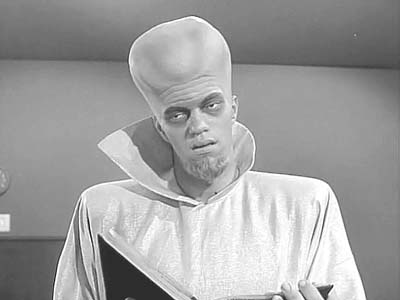
To Serve man - From www.scifi-universe.comFrom www.scifi-universe.com
I have to say it again, a great score by a great composer can raise a film to a whole new level. Just watched yet another Twilight Zone episode, "Nightmare as a Child" (there's 156 or so of them, so I still have a lot to get through). Right from the opening you notice the music, very reminiscent of Ennio Morricone's works. Just like Morricone (remember 'Once Upon a Time in the West' or 'Once Upon a Time in America'), it used a childhood style and theme to put the past into the present, very much in keeping with the story. And who was it? Jerry Goldsmith, of course! Though he wrote only a handful of scores for the series, you notice every one. Excellent!
A day or two back too, I watched 'Little Girl Lost'. You know it's a classic when 'The Simpsons' use it as the basis for an episode (like 'The Shelter' or 'To Serve Man'), and 'Little Girl Lost' serves as the basis for Homer's experience in the Third Dimension. It's also written by Richard Matheson, which helps, although the father's immediate response when his daughter disappears is to 'call a physicist'. Hmmmmm! Perhaps not the most realistic of responses, Richard. Traditionally the third season of The Twilight Zone opens with a 'Produced by' credit, 'Written by', and 'Directed by'. In this episode though and very unusually, the main credit after Producer is 'Music by'. Rightfully so too, for the score is by none other than Bernard Herrmann, frequent collaborator with Hitchcock, composer of the theme and a lot of music for the first season, and one of the all time greats. The score itself is very like earlier scores by Herrmann, it must be said, but it lends a gravitas to the episode that raises it far above the ordinary. Another point: quite apart from The Simpsons, this particular episode obviously inspired 'Poltergeist', right down to the little girl. Excellent!!!!!
And while I'm at it, 'To Serve Man', based on a story by Damon Knight, again a story I read as a child (and loved), I watched the other night too. I must have seen it before, but the punchline is such a good one that it deserves repeated viewing. Richard Kiel as a nine foot tall alien with a huge forehead is also worth the watch. Excellent!!!!!!!!!!!!!!
(There's a bit of trivia relating to 'Naked Gun 2 1/2: The Smell of Fear' mentioned on the wikiepedia entry for 'To Serve Man'. If you know the punchline, it's a good one. If you don't, read the story!!!!!!!! And someone's put the episode on Google! I want to scream out the punchline!!!!!!!!)

Labels: , , , , , , , , ,

Wednesday, March 26, 2008

What Do You Do When the Monks Want to Eat You?

Still Valley - From wikipedia.orgFrom wikipedia.org
I've started to dread the credit "Written by Rod Serling" when watching The Twilight Zone. Don't get me wrong, I've sang his praises in the past and still do; he was a superb craftsman. Too often though he was just too damn matter of fact. Also he sometimes allows his prose to run away with him (a little like Ray Bradbury). Then there are those similar themes surfacing again and again (the little man with a chance of redemption, the Nazi getting his come-uppance, the nostalgic yearning for the past). I watched his later series, 'Night Gallery' recently (and more on that later), but even there the episode that got Emmy-nominated, Serling's "They're Tearing Down Tim Riley's Bar" is a very close reworking of Serling's earlier Twilight Zone episode, 'The Trouble with Templeton'. It's also conspicuously out of kilter with the refreshing darkness of the rest of the series, being hopelessly maudlin (as usual, I'm probably in the minority on this one). Serling at his worst has his characters declaim 'seriously' in sentimental yarns lacking bite. This is the Twilight Zone, Rod, take some drugs, get drunk, have an orgasm, but get out of your dogmatic mind, for goodness sake!
Anyhow! Series Three seems to be a monumental slog by him, every episode signed 'Written by Rod Serling' (it is a prodigious feat of creativity, it must be admitted), but thankfully tonight there was one "Based on a story by Manly Wade Wellman: 'Still Valley'. Not by any stretch a masterpiece, but I recognised it as a story I'd read years ago. Set in the American Civil War, it was about a sorcerer in a Southern States town threatening to overthrow the Union army through witchcraft. The story was better than Serling's adaptation, but it still boosted me no end to see it onscreen. There's a lot in the back catalogues, folks.
Yes, the back catalogue. Once upon a time I wrote a tv series using such tales. Naturally it was never produced, but it did get me noticed by an American couple who ran a small production company. I was 'Shakespeare', they 'loved me', 'Come in and see us!' I did. They didn't want to produce my series. Instead they wanted me to write their script based on a treatment they supplied. It was wonderfully tacky stuff about blind Templar monks coming back from the dead, though there was little to the treatment and what there was was probably ripped off from Amando de Ossorio's BLIND DEAD series of zombie movies about the same subject. Nevertheless I agreed to tackle it.
Asking about a fee though changed the atmosphere. Warmth turned to chill. Between bouts of writing I consulted friends, checked with the Writer's Museum, Filmbase, etc., and the advice was the same; do nothing for nothing! Even if it's a small nominal sum, any payment would show their commitment to me. Otherwise they could have several writers working on the same thing and in the end they could choose whatever version they liked with no monetary loss. I had to have it out with them, and have it out with them I did. I was accused of not trusting them. Well, maybe, but they held all the cards and I was an out-of-work wannabe scriptwriter. I asked for a very small figure, maybe one hundred euros. After all I had done a lot of work at that point (little did they know I actually had a first draft written). No! I was a viper! I shamed them! Down the stairs! I was evicted from the office and that, my friends, was the end of that.
A shame though. I liked that script, if I do say so myself (nice scene in a library; sex scene with a seal), but as they owned the treatment, I don't own the rights. A salutary lesson in scriptwriting taught and learnt in a classroom we fondly call The Twilight Zone.

Labels: , , , , ,

Monday, January 14, 2008

More Notes on The Night Stalker

One big anomaly in Kolchak was having Richard Kiel, Jaws in the James Bond movies, playing an Indian wizard. More convincing by far was Kiel as the lettuce-covered creature, Peremalfait, in one of my most fondly remembered episodes, 'The Spanish Moss Murders'. Probably taking its cue from Swamp Thing and Man-thing, Peremalfait was a huge, green Bogeyman, remembered and unconsciously created by a sleep experiment subject from the Bayou. Kolchak must eventually confront him in Chicago's sewers with what is admittedly a somewhat ridiculous weapon, a whittled piece of Bayou gum tree. The huge Kiel being speared by the little twig is just a little too easy.

The curse of the pathetic make-up surfaces again in 'Mr R.I.N.G' about a homicidal robot. A jump-suited actor with lights on his face strives to make itself human (learning philosophy from St Augustine, among others and using undertaker's wax and a ski mask for that Jason look). I think it's easy to see where the story had its origins when you see that the robot was invented in the 'Tyrell' Institute ('Bladerunner' anyone?). Not bad. Shame about the jumpsuit.

Labels: ,

Wednesday, January 09, 2008

Kolchak: The Night Stalker


After all my talk of books, it's sad to say I've spent the last two nights watching dvds. My buying frenzy was confined not only to literature, you see, and a week or so back I found a rake of old, macabre shows online for cheap as chips prices. Sadly none arrived while I was off work (I had planned one long day of watching), but on Monday 'Kolchak: The Night Stalker' was finally delivered.
I have fond memories of the 1974 show from my childhood, when it was repeated on late night BBC2. Starring Darren McGavin as the eponymous journalist, each week it featured a new monster or supernatural threat that Kolchak would investigate and usually dispatch, before finding evidence for his story go up in smoke (quite literally, most of the time). The type of show that a growing kid likes to see and I haven't grown up that much since.
Of course, it's all very cheap and tacky, and the horror elements are probably not helped by the gentle comedy thrown into each episode. The only thing scary about the Werewolf episode, for instance, is that they actually allowed such shoddy make-up on to the screen (Jack Pierce this isn't). But there is still an appeal about the show. I splurged on eight of the twenty episodes already and though there is a standard formula - Kolchak sees a strange pattern in apparently mundane events, identifies (correctly) a malevolent supernatural force, tries to convince everyone, fails and has to kill the beast himself - there is enough originality in the 'Monster of the Week' to keep you entertained.
For instance, take the first episode concerning the original Jack the Ripper. Mysteriously he pops up (as a veritable Spring-heeled Jack) in Chicago and must eat the kidneys of five women to be reborn. Kolchak delving into the records, discovers several 'Ripper' copycats since the famous London murders and jumps to the 'logical' conclusion that they are all the one superhuman killer. Anyone remember the 'Tooms' episodes from 'The X-Files'? Very similar. This should be no surprise, as 'X-Files' creator, Chris Carter, has publically acknowledged the influence of the Kolchak series on his own.
Other clever twists on old standards populate the rest of the series; a werewolf on a singles cruise ship; an incredibly politically incorrect episode on an underworld zombie (featuring Antonio Fargas - Huggy Bear from 'Starsky and Hutch' - and Scatman Crothers - The Shining); a firestarting doppelganger. Tom Skerrit, of 'Alien' and 'The Dead Zone', pops up memorably as a Satanist politician (aren't they all?) headed for the Senate. Add in a treasure seeking Indian sorcerer and a vampire hooker and you have what 'The X-Files' might have been without all that 'Smoking Man and the Aliens' nonsense. Not that aliens don't figure too. In one authentically funny scene, a UFO nut proclaims the following before having his bone-marrow sucked out by a malign alien:
"You are on the third planet of our solar system. We are peaceful. I will now speak to you in the universal language of Mathematico. Arrrrgggggggghhhhhhhhhhh!"

Needless to say 'Mathematico' was his own invention.
American television recently tried to remake the series with Stuart Townsend in the Carl Kolchak role, but after six episodes broadcast the series was pulled (although another four episodes had been made). Critics complained that it was too much like 'The X-Files'.

Labels: , ,

Thursday, April 26, 2007

Crying Fowle!

But I did get to Dublin eventually. Back nearly two weeks now, I had an initial burst of energy, getting out of bed early and sorting out insurance claims etc.. This enthusiasm, however, has started to flag. Nothing has changed. Unlike Thailand, this is same same, no different. Even the few conversations I have had with my work mates reveal a DCU with all the familiar virtues and flaws.

Last Sunday I joined Justin, Jules and Killian for a night out on the town. I found out that even I had not changed, enthusiastically chatting up Bulgarian students and passers by on the street, acting as relatively sober adjudicator in fast food altercations, and picking Justin up off the ground. Same same, no different.

Yesterday I took out my machete and cut through the final two hundred pages of John Fowles' 'The Magus'. It frustrated me. Thoroughly infuriating. Not since reading Guy Endore's 'The Werewolf of Paris' (a book which profoundly depressed me), has a piece of fiction altered me mood so dramatically. I felt ready to burn the novel after I was finished. In some ways it reminds me of Matheson's '7 Steps to Midnight', but is infinitely better written and with loftier aims. As I said before, Fowles can write. He has a skill that surpasses most contemporary writers. However, skill is one thing, intention another. I can accept that fiction can have an educational purpose (witness "1984"), but the more I read the more I find moralising by an author intolerable. That was one of my main gripes about the work of Salinger, and, for all that Fowles is a far superior craftsman, it certainly pertains to this novel as well. The lead character, Nicholas Urfe, is painted deliberately as an unsympathetic reprobate, and for most of the novel I sympathesised with those critics who regarded the novel as cold. Urfe is not someone you can easily identify with. Nevertheless, he is recognisably human, unlike his adversaries. To ascribe moral superiority to the forces that torment him is a celebration of sadism and an insult to the reader. To hold Urfe's new self up as an example of chastened maturity, as Fowles evidently intends, to accept his attitude to the other characters of the book as the right approach to take, is a demonstration of authorial smugness I find detestable. I feel that if I ever meet Mr Fowles I will deal him a slap not unlike the one Nicholas deals to Alison, and for pretty similar reasons. I can love his talent, who he is, but despise his intention, what he does with it. I could go on and on about this book, but what few people read this blog, have no doubt precious little interest in my literary opinions, so I'll stop here. Nevertheless, for anyone with eyes, it will be apparent that for a novel to have such a strong effect - negative or positive - it must be a special work, and 'The Magus' is. I tip my hat, however begrudgingly, to you, Mr Fowles.

It was something of a relief to leave the heady heights of Fowles' sermonising and take up Dick's 'The Penultimate Truth'. This is Philip K. Dick from around the time he wrote 'The Man in the High Castle'. The style is simple and clear, the plot full of the invention that characterises Dick at his best. Fresh air.

On the media and culture front, I have also taken to watching 'South Park' on the bus, via my new gadget from Hong Kong. There is an episode where Cartman fools Butters into believing the world has been devastated by an asteroid in order to make him hide out in a bomb shelter for a week. This so that Cartman can take Butters' place with Kyle et al. in going to a Mexican theme restaurant called Castle Bonita. I don't think I have seen such a clever use of B-movie cliches in a parody before. It even managed to give Cartman dimensions we have seen again and again in noir villains, but which still managed to resonate in a new way. Cartman speeding around Castle Bonita while the cops closed in was an unforgettable finale, worthy of a James Cagney or John Garfield. See what I am reduced to.

Labels: , , , , ,